
I’ve worked in startups and scale-ups for over 15 years, including two particularly fast-growing B2B SaaS companies.
I’ve seen companies grow, succeed, struggle, reorganize and reinvent the way they work along the way.
And while every company is different, I kept seeing similar patterns emerge.
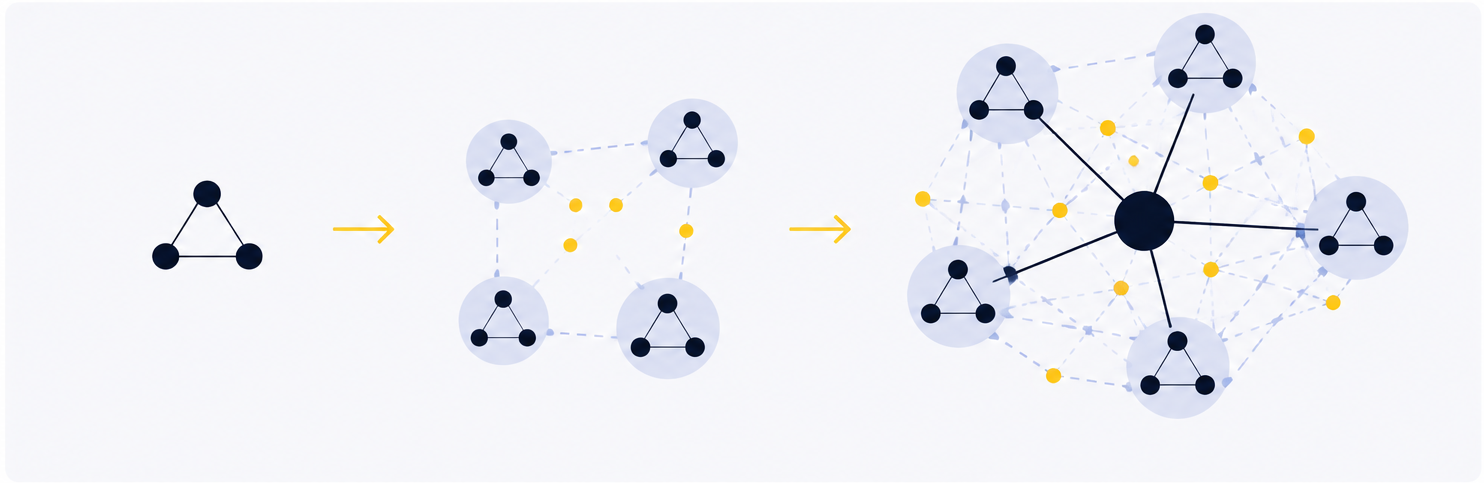
Growth changes more than headcount. It changes how companies make decisions, set priorities and get things done.
I joined Lengow when we were nine people. By the time I left, three years later, the company had grown to around 100.
A few months later, I moved to Akeneo, where I spent ten years as the company grew from around 30 to more than 450 people.
Both were B2B SaaS companies, with different products, leaders and journeys. Yet many of the organizational challenges that appeared as they grew felt surprisingly familiar.
I’m sharing these observations because some of these changes are easier to navigate when you can see them coming. What works at 30 people doesn’t always work at 100, 250 or 400, and understanding why can help teams adapt before execution starts to suffer.
In a small company, there is little bureaucracy. People work closely together and information travels fast. When a decision needs to be made, the people involved can usually talk directly. And when something needs to get done, there often isn’t a dedicated team, process or project manager to take care of it.
You figure it out and make it happen. But as the company grows, this starts to change.
Teams specialize. New layers of management appear. Objectives and OKRs multiply. Fundraising and growth targets create new expectations for founders and leadership.
Sharing context across the company becomes harder. A decision that once involved three people can now involve three teams.
The challenge isn’t the lack of direction or ideas. It’s turning that direction into consistent execution as the organization becomes more complex.
Here’s how I’ve seen these dynamics evolve at different stages of growth.
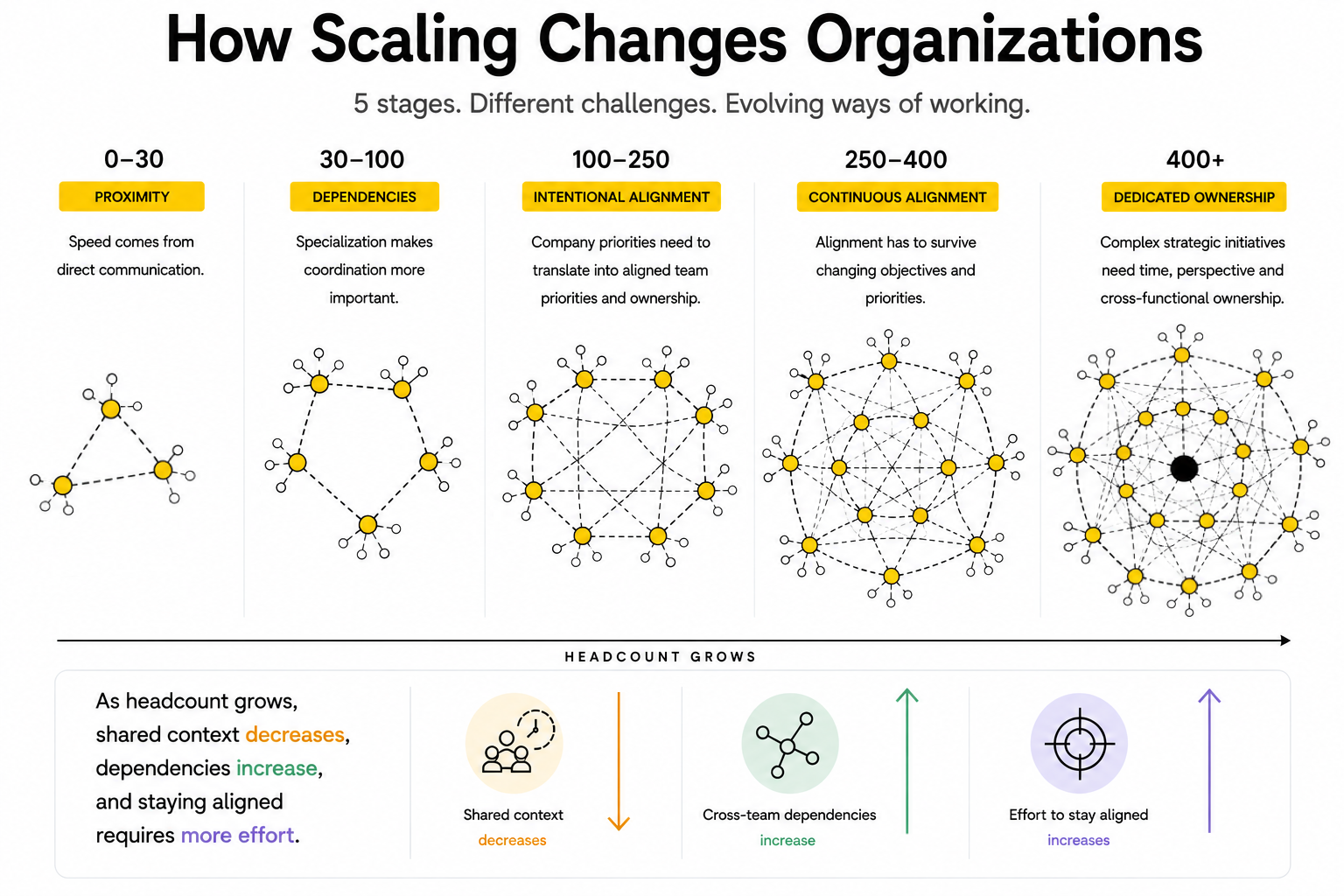
0–30 people: speed comes from proximity
At this stage, team proximity and fast communication do much of the work.
People tend to have a broad understanding of what’s happening across the company because they interact constantly: when a decision needs to be made, the people impacted by it are usually easy to reach.
Priorities can change quickly because new context spreads quickly too.
There are also fewer boundaries around ownership. Not every responsibility has a dedicated function, process or owner yet. If something matters and nobody is explicitly responsible for it, someone steps in and gets it done.
That creates a particular kind of speed.
Processes can stay lightweight because coordination happens directly between people. You don’t need a formal governance model for every decision or initiative when the relevant people can simply get together and resolve it.
This doesn’t mean small companies are easier to run. They face different challenges: limited resources, uncertainty, constantly changing priorities and the pressure to move fast.
But organizational coordination usually isn’t the main constraint yet.
30–100 people: dependencies start to appear
Growth brings specialization.
Sales becomes a real organization. Marketing develops its own priorities. Product expands. Customer Service functions grow. New managers and functional leaders join, and the leadership team itself becomes more structured.
This specialization is necessary, but also creates more dependencies between teams and, over time, can create silos between functions.
People no longer know everything happening elsewhere in the company. Each function develops its own goals, roadmap and ways of working. And decisions made by one team can now start to impact others.
For instance, a Product decision to delay a feature can affect a Marketing launch already in preparation, Sales opportunities where the feature was part of the conversation, and Customer Success commitments or expectations with existing customers.
As these dependencies multiply, working across teams requires more intentional coordination. The quick conversations that worked when everyone shared the same context are no longer enough.
The organization can still move fast, but staying aligned starts to require more effort.
100–250 people: when execution gets harder
This was the stage where I really started noticing the change.
Earlier at Akeneo, I had worked on strategic initiatives with very small core teams. Our Community Edition to Enterprise conversion program, for example, was initially driven by one Product Manager, one developer and one Product Marketing Manager (me).
There were few dependencies, communication was direct, and coordination was relatively easy.
A few months later, the Free Trial initiative was completely different.
It was a highly strategic project involving Product, Design, Engineering, Support, Internal IT, Marketing, Sales, Product Marketing and even the CEO.
But being strategic for the company didn’t automatically make it a priority for every team involved. And this is a critical difference.
Some people were directly accountable for the success of the Free Trial, but for most of the other teams involved, the Free Trial was one priority among many. They had their own goals, roadmaps and commitments to deliver. Product had its roadmap. Engineering had capacity constraints. Marketing had its own priorities. Sales had targets to hit.
So when trade-offs had to be made, the Free Trial didn’t always come first.
This created a new kind of challenge: the project depended on people and teams whose priorities I didn’t control.
Moving it forward required much more than a project plan. It meant making responsibilities explicit, getting decisions made, negotiating resources and priorities, resolving blockers and making sure everyone stayed aligned on the objective.
That’s when I understood that calling something a company priority isn’t enough. The teams involved need to stay aligned on the objective, make it part of their own priorities, and know exactly what they own.
250–400 people: alignment becomes harder to maintain
At a greater scale, I noticed another challenge.
Getting teams aligned at the beginning of a strategic initiative was no longer enough. For programs running over several months or years, keeping teams aligned became harder as priorities changed over time.
I experienced this while leading a cross-functional program to support Akeneo’s transition from PaaS and On-Premise deployments to SaaS.
The program was a company priority, supported by leadership and involving multiple teams across the organization.
Customer Success team was particularly critical. Migrating existing customers required CSMs to engage with them, explain the transition, address concerns and help move migrations forward.
At the beginning, the SaaS migration was clearly part of their priorities. But as the program progressed, business priorities changed.
New objectives appeared. Teams received new priorities. Customer-facing teams had other commitments and targets to deliver. Some CSMs who were essential to the migration program had less time and fewer incentives to focus on it. And I started to see the program stall.
Nobody decided that the SaaS transition was no longer important. But when people have several competing priorities, they naturally focus on the objectives they are expected to deliver. As a result, a program that had strong alignment at the beginning gradually lost momentum.
Keeping it moving required regularly checking whether priorities were still aligned, identifying where ownership or capacity had changed, escalating trade-offs when necessary, and bringing the right people back around the shared objective.
With this project, I learned that alignment is never a given. Even when everyone is aligned at kickoff, alignment has to be maintained as the organization and its priorities change.
400+ people: strategic initiatives need dedicated ownership
New stage, new pattern.
Some strategic initiatives were initially led by senior leaders alongside their day-to-day responsibilities. They had the authority to make decisions and a clear understanding of why the initiative mattered. But several months in, some of these projects were struggling to move forward.
It wasn’t a leadership problem. The initiatives had simply become too complex to manage on the side: too many teams involved, dependencies and decisions that needed continuous follow-up. Meanwhile, the leaders sponsoring them still had a function to run, their own objectives to deliver and dozens of other priorities competing for their attention.
I experienced this firsthand with a customer segmentation initiative. The project had been sponsored and initially led by a senior leader, but after several months, progress was slower than expected and the initiative was running late. The scope of the initiative was broader than initially expected, it impacted the whole company, and driving it forward required more time and cross-functional coordination than one executive could realistically provide alongside their day-to-day responsibilities.
The VP leading the initiative asked me to step in and take over the program.
My role wasn’t to redefine the strategy or replace the executive sponsor. It was to create the conditions for execution: step back and look at the initiative end to end, make sure the full scope was covered, identify teams or dependencies that had been missed, understand what was blocking progress, clarify ownership, surface decisions that needed to be made, and keep the initiative moving until completion.
Being outside any single function gave me a broader view of the organization and the ability to look at the initiative objectively, without representing the priorities of one particular team. It made it easier to see how decisions, constraints or priorities in one area affected another.
What I learned at this stage is that authority isn’t enough to move a complex initiative forward. The person in charge needs the time, the full picture and the mandate to drive it across the organization.
The exact numbers don’t really matter
Of course, these thresholds (0-30, 30-100, 100-250..) aren’t rules.
A 150-person company operating across several countries, products or markets may already face more organizational complexity than another company with 300 employees.
What matters is the pattern. As companies grow, shared context decreases, cross-team dependencies increase, priorities multiply, and staying aligned requires more effort.
The ways of working that helped a company move fast at 30 people won’t necessarily work at 100, 250 or 400.
And that’s perhaps my biggest learning from experiencing these different stages of growth: as a company grows, the way people make decisions, set priorities and work together needs to evolve too.
Early on, the question is often: What should we do next?
As the organization grows, another question becomes just as important: How do we get the organization to execute it together?
Because scaling a company isn’t just about growing the business. It’s about learning how to work differently as you grow.