

Companies invest significant time and resources trying to better understand their market, improve their products, and increase their win rates.
One of the richest sources of insight is often already there: the opportunities stored in your CRM — provided, of course, that the data is reliable and consistently maintained.
Every opportunity, won or lost, tells a story about what buyers value and why they ultimately choose one solution over another. Understanding those decisions is one of the most valuable sources of market intelligence a B2B SaaS company can have.
Looking beyond the numbers
One of the most insightful project I led was building a company-wide win-loss analysis program.
Its objective wasn’t simply to report on sales performance. It was to understand buying behaviors, identify recurring patterns across markets and segments, and transform those insights into concrete actions for Product, Product Marketing, Sales, and Revenue Operations.
It required patience and rigor: weeks of reviewing opportunities, consolidating CRM data, analyzing competitive trends, and speaking with Sales and Pre-Sales teams to understand what had really happened behind each deal.
What fascinated me wasn’t the numbers. It was the why behind them.
One insight surprised us in particular: our competitive landscape varied significantly by geography and customer segment, so did our win rates.
Some competitors barely appeared in EMEA but dominated conversations in North America. Others were almost exclusively present in specific industries, or for specific segments.
It was something we had not realized.
That project taught me something fundamental:
Win-loss analysis isn’t really about measuring performance. It’s about understanding customer perception.
Once you start looking at it that way, it becomes one of the most powerful strategic growth levers a company can have.
Why win-loss analysis matters
Most organizations celebrate their wins and quickly move on from their losses.
But both are equally valuable.
Every opportunity contains signals about your market, your positioning, your product, and your go-to-market strategy. A structured win-loss program helps companies move beyond assumptions and replace opinions with evidence.
Instead of asking “What do we think happened?”, teams can finally answer: “What actually influenced the customer’s decision?”
What you can learn
A good win-loss analysis uncovers much more than who won the deal.
It helps reveal:
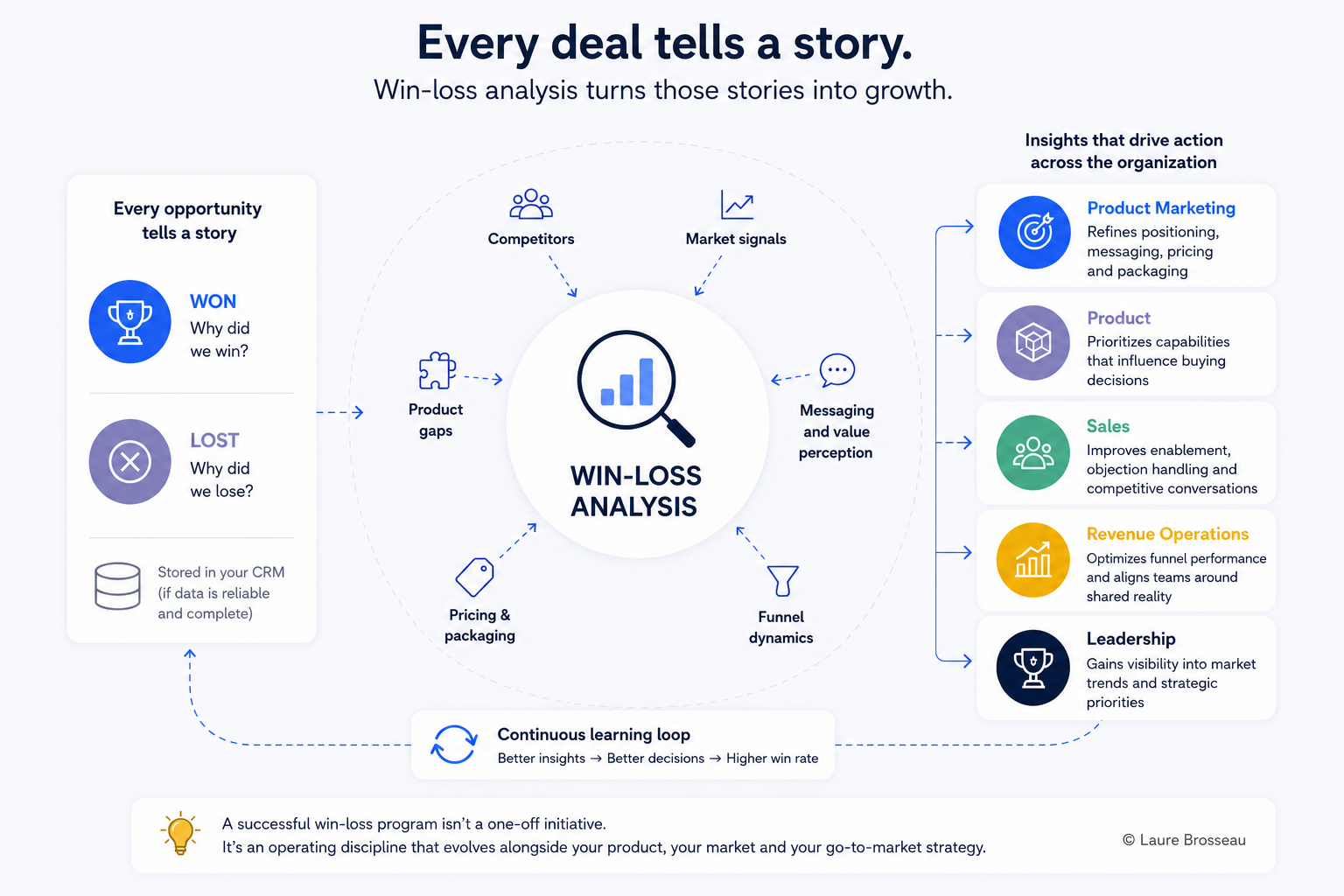
- Market signals: who buyers are comparing you against and why.
- Competitive dynamics: which competitors appear most frequently by region, segment, or industry.
- Product gaps: the missing capabilities that repeatedly block opportunities.
- Messaging effectiveness: how buyers actually perceive your value proposition.
- Pricing and packaging insights: where commercial offers create friction.
- Sales execution: whether enablement and positioning support the buying journey.
- Funnel dynamics: where opportunities stall and why.
Over time, patterns begin to emerge, and those patterns are often far more valuable than any individual deal.
Turning insights into action
The real value isn’t the report. It’s what happens afterwards.
When insights are shared across the organization, every team can make better decisions.
- Product Marketing refines positioning, messaging, pricing, and packaging.
- Product prioritizes capabilities that genuinely influence buying decisions.
- Sales improves qualification, objection handling, and competitive conversations.
- Revenue Operations identifies funnel bottlenecks, improves conversion rates, and aligns teams around a shared understanding of reality.
- Leadership gains a clearer picture of market trends and strategic priorities.
That’s when win-loss analysis stops being a reporting exercise and becomes a strategic operating system.
How to make it work
The recipe is simple.
Treat every opportunity, won or lost, as valuable data.
Build a repeatable process.
Encourage Sales and Pre-Sales teams to document opportunities consistently.
Most importantly, create a culture where the objective isn’t to evaluate individual performance but to learn from the market.
The goal isn’t to ask: “Who lost this deal and why?”
It’s to understand: “What can this deal teach us?”
A win-loss program should also evolve over time.
As your company grows, you’ll unveil new competitors, new buying criteria, new product gaps, and reasons for loss that no longer reflect reality.
Keep refining your CRM fields, update competitor lists, maintain missing feature catalogs, and regularly review your win-loss reasons. The quality of your insights will only ever be as good as the quality of the data you collect.
Finally, close the loop.
Share insights beyond leadership teams.
The more Product, Marketing, Sales, and Customer Success understand the market through the same lens, the stronger the entire organization becomes.
A successful win-loss program isn’t a one-off initiative. It’s an operating discipline that evolves alongside your product, your market, and your go-to-market strategy.
Every deal is market intelligence
Win-loss analysis isn’t about assigning blame or celebrating success.
It’s about understanding how your market evolves, where your company creates — or fails to create — value, and what buyers truly care about.
Companies that systematically learn from every opportunity don’t just improve their sales performance.
They build better products, stronger positioning, and more effective go-to-market strategies.
Every deal is an opportunity to learn.
The companies that grow the fastest are often the ones that listen most carefully.